-
Search this website
-
Blog Categories
-
External Links
| Call no.: | HYG-2079-97 |
|---|---|
| Author: | William F. Lyon, James E. Tew |
| Common Name | Scientific Name |
|---|---|
| Honey Bee | Apis mellifera (L.) |
The honey bee benefits the economy immensely. Honey bees produce millions of dollars worth of honey and beeswax, as well as pollinate commercial fruits, vegetables, and field crops. However, by establishing a colony in a house, building, or hollow tree next to the home, honey bees may become a nuisance or hazard to humans. Some people have severe allergic reactions to the sting of a honey bee. Although it is not unlawful to destroy honey bees, it is always best to save them if possible. Identification
Honey bees are characterized by the presence of a long, pointed tongue, social habit, front wings with three closed submarginal cells, and no spurs at the tips of the hind Tibiae (4th segment of the insect's leg). Adults consist of three castes: queens (3/5- to 3/4-inch long) are fully developed egg layers with only one in each colony; drones (3/4- to 5/8-inch long) are functional males; and workers (2/5- to 3/5-inch long) are undeveloped females.
The first honey bees introduced from Europe were black German bees. The common Ohio variety of honey bee is the Italian, which is a golden-brown and black bee covered with short, dense hair. The forepart of the abdomen is yellow and there is some yellow between the four brown bands on the rest of the abdomen. The Caucasian variety, a mild-tempered bee, is dark, and its abdomen is banded with gray. The carniolan is a gray bee similar in appearance to Caucasian. Most people see only the workers, which regularly fly in and out of the nest.
Contents |
The queen is the only female in the colony capable of laying fertilized eggs. She is extremely important, because without her no young bees would be replacing the old bees as they die. The rest of the bees pay a lot of attention to her. There is only one queen to each bee colony, and she may live two to five years. She must be fed by the others in the colony, and she can do none of the rest of the chores that need to be accomplished to make honey and keep a clean nest.
Drones are male bees within the colony. There may be several hundred drones in the spring and summer, but they are all eliminated in the fall and winter when their services are no longer wanted. The drone develops from unfertilized eggs and exists only to fertilize or mate with young queens. He typically lives 40 to 50 days, and is bigger than either the queen or workers.
The majority of bees in colony are worker bees. They perform most of the functions bees are known for, such as making honey and stinging for defense. Although workers are females, they cannot lay fertilized eggs. There may be as many as 60,000 workers in a colony, though the average figure for the whole year is 30,000.
Workers live only 40 days in the summer, but may live several months during winter. Some gather nectar and pollen in the field; others process the honey. Usually, the workers perform their duties based on age. The younger ones are cleaners and helpers. The older, more experienced bees, are builders and do the foraging in the field.
The nest is the comb on which the bees rest, rear brood, and store honey. The comb is constructed of wax. It has a central rib, with six-sided cells constructed on each side parallel to the ground. The cells are the storage area for the bee colony and at the same time serve as the nursery for rearing young bees.
The life cycle of the brood is egg (3 days), larva (6 days), pupa (12 days) for a total of 21 days from egg to adult worker. This cycle is longer (24 days) for drones and shorter (16 days) for queens.
An established honey bee colony will sometimes divide itself, and one or more swarms will leave the hive. The new swarm may cluster for a while on a tree limb or bush near the old hive while scout bees search for a suitable place to establish a new home. Usually scout bees find a hollow tree, but occasionally they will choose the wall voids of a home. Unfortunately, bees may nest in the wall or attic some distance from where they enter the wall.
Carbaryl (Sevin) 5 percent Dust is an insecticide registered to exterminate bees from dwellings. If it is not applied properly, persistent efforts may be needed to finally accomplish the job. Sevin dusted into the bee entrance may not reach the nest, which may be some distance from the entrance. Foraging bees passing through the dusted area will be killed, but the queen and house bees that stay home to take care of brood and tend to the nest may continue to live for some time. When house bees (young bees that remain in the hive) mature to take on field work chores, the colony may recover, unless the insecticide treatment is reapplied. Quicker and surer results will be received if the nest itself is treated.
The nest can be located sometimes by tapping the wall with a hammer and listening for an answering buzz from the bees. When the nest is located, a hole may be bored, preferably through the outside wall, so insecticide can be applied onto the nest.
Established swarms are comprised of more bees, more comb, and more honey. Established colonies are best killed in late winter or early spring when their population is smallest. Treatment is effective when done in the very early spring, such as February or March, when stored honey is at its lowest level and the bee population is lowest and weakest. New swarms are more easily killed soon after they enter the building. The best time of day to apply the insecticide is late afternoon when all the bees are at home. The bees will be less cross on nice days than when the weather is overcast or rainy. Do not plug the hole immediately after dusting the nest because this may force the agitated bees into the living quarters of the home. Bees will find or make unused or new exits, sometimes indoors. Also, honey bees can be killed by exposing the nest to freezing temperatures during the winter.
After the bees are killed, remove the nest if at all possible, without causing excessive structural damage. Destroy the comb and honey, especially if they were treated with insecticide. If the nest is not removed, the wax cells may melt or be riddled by wax moths and leak honey. Excess honey may seep through interior walls and ceilings, leaving permanent stains.
Wax combs near the inside walls of a chimney are fire hazards. The comb and its contents may melt when exposed to hot summer temperatures without bees to keep it cool, especially in walls facing the south.
After a dead colony has been removed and the structural damage caused in removing the colony has been repaired, clean the area thoroughly with soap and hot water. Paint and carefully plug all entrances through which the other possible bee swarms might enter. Odors left by the killed colony can linger for a long time and attract other swarming bees.
Pest control companies may be contacted to destroy the bees if needed. Although killing adult bees is usually fairly easy, removal of the comb and honey can be very difficult. It might be useful to have a beekeeper and carpenter or beekeeper with carpenter abilities present to assist. Bees from other colonies can also be a nuisance around the home as long as honey remains to be robbed from the killed colony. Scavenging insects, such as carpet beetles, wax moths, ants, or flies, are also attracted to killed bee colonies.
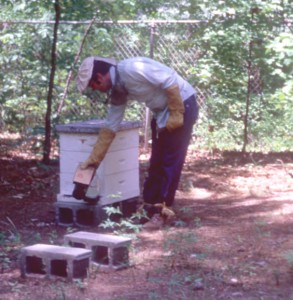
Even if you are not sensitive to stings and are experienced in extermination work, it is best to be protected from distracting stings when exterminating bees. You may be in precarious positions, such as on a ladder or on a roof, with stinging bees present. At least wear a beekeeper's veil and leather gloves.
A bee smoker is valuable to help calm the bees and lessen their tendency to sting.
Honey bees can be removed effectively by trapping; however, the process takes four to six weeks. While it solves the problem of opening up the wall and removing the comb and honey, it may not be appropriate if family members are allergic to bee stings.
To trap, place a wire mesh cone (18-inches long with 3/8-inch opening at the apex) over the nest entrance hole. Place a hive containing a queen and a few workers as close as possible to the "trap." The bees can leave the building, but they cannot get back in and will settle in the decoy hive. In three to four weeks, spray the old nest with a nonresidual insecticide, such as resmethrin, to kill the queen and any remaining workers. Then remove the trap and allow the bees in the decoy hive to go back in the building to retrieve their honey. Two weeks later, remove the hive and close up the nest entrance. Destroy the honey if the colony has been poisoned with an insecticide. Trapping is usually not practical and results may be unsatisfactory. Few beekeepers are interested in trapping. Established swarms (those with comb) cannot be collected easily like the free-hanging temporary swarms and are usually not economical for a beekeeper to remove.
Allowing swarms of honey bees to leave on their own is often the best approach. A swarm of bees will remain clustered until scout bees have located a suitable site for permanent nesting. In two days or less, the swarm will usually break the cluster and fly away. If it is necessary to remove a swarm, be sure to contact a local beekeeper, who usually will be happy to get the swarm of bees and provide them a new home. Names of beekeepers willing to take swarms are available at the Ohio State University County Extension Office, Ohio State University Extension Entomology Department, and Ohio Department of Agriculture, Apiary Section. Although not recommended, the swarm can be killed or eliminated when sprayed, from a distance, with a resmethrin-based wasp and hornet spray, or with carbaryl (Sevin) or propoxur (Baygon). Wear protective clothing with bee veil if possible, and leave the area quickly after treatment. Spraying makes bees angry.
Treat nests with dusts of carbaryl (Apicide, Sevin), bendiocarb (Ficam D), or pyrethrins (Microcare), or sprays of Sevin, diazinon, or propoxur (Baygon). Sprays may not penetrate the nest well enough to give good control.
Additional insecticide formulations that only the licensed pest control operator can use include acephate (Orthene), bendiocarb (Ficam W), bendiocarb plus pyrethrins (Ficam Plus), bifenthrin (Biflex), cyfluthrin (Tempo), fenthion (Baytex 4), pyrethrins (Exciter, Kicker, Pyrenone), cypermethrin (Cynoff, Cyper-Active, Demon, Vikor), chlorpyrifos (Dursban), deltamethrin (Suspend), permethrin (Dragnet, Flee, Prelude), resmethrin (Synthrin, Respond), and tralomethrin (Saga).
All educational programs conducted by Ohio State University Extension are available to clientele on a nondiscriminatory basis without regard to race, color, creed, religion, sexual orientation, national origin, gender, age, disability or Vietnam-era veteran status.
Issued in furtherance of Cooperative Extension work, Acts of May 8 and June 30, 1914, in cooperation with the U.S. Department of Agriculture, Keith L. Smith, Director, Ohio State University Extension.
TDD # 1 (800) 589-8292 (Ohio only) or (614) 292-1868