-
Search this website
-
Blog Categories
-
External Links
| Call no.: | HYG-2075-97 |
|---|---|
| Author: | William F. Lyon |
| Common Name | Scientific Name |
|---|---|
| German Yellowjacket | Paravespula germanica (L.) |
| Eastern Yellowjacket | Paravespula maculifrons (Buysson) |
| Common Yellowjacket | Paravespula vulgaris (L.) |
Yellowjacket wasps often become a nuisance in Ohio, especially from August through October, as they build up in large populations and scavenge for human food (carbonated beverages, cider, juices, ripe fruits and vegetables, candy, ice cream, fish, ham, hamburgers, hot dogs, etc.) at picnics, cookouts, outside restaurants, bakeries, campsites, fairs, sports events and other outdoor get-togethers. Many are attracted in large numbers to garbage cans and other trash receptacles. Others fly in and out of nests built around homes, buildings and areas where people live, work and play, causing fear and alarm. Although yellowjackets are considered quite beneficial to agriculture since they feed abundantly on harmful flies and caterpillars, it is their boldness (sometimes aggressiveness) and painful stinging ability that cause most concern. Nevertheless, unless the threat of stings and nest location present a hazard, it is often best to wait for Mother Nature, with freezing temperatures in late November and December, to kill off these annual colonies. Stinging workers do not survive the winter and the same nest is not reused.
Contents |
A typical yellowjacket worker is about 1/2-inch long, short and blocky, with alternating black and yellow bands on the abdomen while the queen is larger, about 3/4-inch long. (The different black and yellow patterns on the abdomen help separate various species.) Workers are sometimes confused with honey bees, especially when flying in and out of their nests. Yellowjackets, in contrast to honey bees, are not covered with tan-brown dense hair on their bodies and lack the flattened hairy hind legs used to carry pollen. Yellowjackets have a lance-like stinger without barbs and can sting repeatedly whereas honey bees have a barbed stinger and sting only once. Some have yellow on the face. Mouthparts are well-developed for capturing and chewing insects with a tongue for sucking nectar, fruit and other juices. Nests are built in trees, shrubs or in protected places such as inside human-made structures (attics, hollow walls or flooring, in sheds, under porches and eaves of houses), or in soil cavities, mouse burrows, etc. Nests are made from wood fiber chewed into a paper-like pulp.
Yellowjackets are social wasps living in colonies containing workers, queens and males. Colonies are annual with only inseminated queens overwintering. Fertilized queens occur in protected places as hollow logs, in stumps, under bark, in leaf litter, in soil cavities and human-made structures. Queens emerge during the warm days of late April or early May, select a nest site and build a small paper nest in which eggs are laid. After eggs hatch from the 30 to 50 brood cells, the queen feeds the young larvae for about 18 to 20 days. Larvae pupate, emerging later as small, infertile females called workers. By mid-June, the first adult workers emerge and assume the tasks of nest expansion, foraging for food, care of the queen and larvae, and colony defense. From this time until her death in the autumn, the queen remains inside the nest laying eggs. The colony then expands rapidly reaching a maximum size of 4,000 to 5,000 workers and a nest of 10,000 to 15,000 cells in August and late September. At peak size, reproductive cells are built with new males and queens produced. Adult reproductives remain in the nest fed by the workers. New queens build up fat reserves to overwinter. Adult reproductives leave the parent colony to mate. After mating, males quickly die while fertilized queens seek protected places to overwinter. Parent colony workers dwindle, usually leaving the nest and die, as does the foundress queen. Abandoned nests rapidly decompose and disintegrate during the winter. Nests inside structures will persist as long as they are dry. Nests are not used again. In the spring, the cycle is repeated. (Weather in the spring is the most important factor in colony establishment.) Although adults feed primarily on items rich in sugars and carbohydrates (fruits, flower nectar and tree sap), the larvae feed on proteins (insects, meats, fish, etc.). Adult workers chew and condition the meat fed to the larvae. Larvae in return secrete a sugar material relished by the adults. (This exchange of material is known as trophallaxis.) In late autumn, foraging workers (nuisance scavengers) change their food preference from meats to ripe, decaying fruits since larvae in the nest fail to meet requirements as a source of sugar.
In 1975, the German yellowjacket first appeared in Ohio and has now become the dominant species over the Eastern yellowjacket. It is bold, aggressive and, if provoked, can sting repeatedly and painfully. The German yellowjacket builds a grey, brittle, papery soccer or football shaped nest in structures with the peak worker population between 1,000 to 3,000 individuals between May to November. The Eastern yellowjacket builds a tan, fragile papery soccer or football shaped nest underground with the peak worker population between 1,000 to 3,000 individuals between May to November similar to the Common yellowjacket. Nests are built entirely of wood fiber (usually weathered or dead) and are completely enclosed (football or soccer shaped) except for a small opening (entrance) at the bottom. The nest may be located below the soil or aerial with the paper envelope covering containing multiple, horizontal tiers of combs (10 or more) within. Larvae hang down in combs.
It is always best to avoid unnecessary stings. Should a yellowjacket wasp fly near you or land on your body, never swing or strike at it or run rapidly away since quick movements often provoke attack and painful stings. When a wasp is near you, slowly raise your hands to protect your face remaining calm and stationary for a while and then move very slowly (avoid stepping on the ground nest), backing out through bushes or moving indoors to escape. Wasps and bees can fly about six to seven miles per hour so humans can outrun them. However, by the time one starts running, there could quickly be a dozen or so painful stings caused by the rapid movement. There is an old saying that "one who stands still and shoots an aerial nest with a shotgun need not fear, instead it is the person that rapidly runs away who gets all the stings." Never strike, swing or crush a wasp or bee against your body since it could incite nearby yellowjackets into a frenzied attack. Wasp venom contains a chemical "alarm pheromone," released into the air, signaling guard wasps to come and sting whomever and whatever gets in their way. Unfortunately, many serious accidents have resulted when one runs away from attacking wasps and into the path of automobiles. When a bee or wasp gets into a moving car, remain calm. They almost never sting when in enclosed spaces as a car or house. Instead, they fly against windows. Slowly and safely pull over off the road, open the windows and allow the escape.
Be careful not to cut weeds or run the lawnmower over a ground nest nor disturb a nest in a tree or eaves of the home. Any noise and disturbance will sometimes infuriate and provoke painful stinging. Restrain children from throwing rocks or spraying water on nests.
When eating outdoors, keep food covered until eaten, especially ripe fruit and soft drinks. Any scent of food caused by outdoor cooking, eating, feeding pets or garbage cans will attract many bees and wasps (especially yellowjackets in late summer and early autumn). Keep refuse in tightly sealed containers with tight-fitting trash can lids. Cleaning of dumpsters and garbage containers daily may be required at certain times of the year. (Good sanitation is most important.)
Pick fruits as soon as they ripen. Pick up and dispose of any fallen fruit rotting on the ground. (Overripe pears and apples on the ground attract many yellowjackets.)
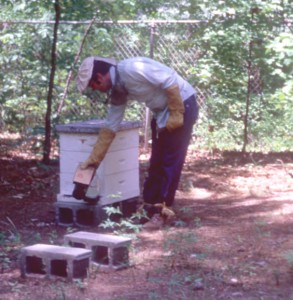
Individuals should avoid attracting insects by not wearing perfume, hair spray, hair tonic, suntan lotion, aftershave lotions, heavy-scented soaps, shampoos and other cosmetics when visiting areas where bees and wasps are prevalent. Avoid shiny buckles, earrings and jewelry, bright, colored, flowery prints (especially bright yellow, light blue, orange, fluorescent red), black, wool, and loose-fitting clothing that may trap stinging insects. Beekeepers wear light-colored (white or light tan) cotton clothing, bee gloves, bee veil, long sleeves and coveralls to reduce unnecessary multiple stings. Wear a hat and closed shoes (not sandals or barefoot). There are no jackets (clothing) impregnated with chemicals repellent to yellowjackets. Hypersensitive persons should never be alone when hiking, boating, swimming, golfing, fishing or participating in any outdoor activity since help may be needed to start prompt emergency treatment measures if stung. It is wise to carry or have an identification bracelet or necklace, such as "Medic Alert," to alert others when sudden shock-like (anaphylactic) symptoms or unconsciousness (fainting) occurs after one or more stings. Medic Alert tags can be purchased from Medic Alert Foundation, Box 1009, Turlock, California 95380 (Telephone 209-668-3333).
After being stung, immediately apply a poultice of a meat tenderizer to the wound. If the sting is not deep, this will break down the components of the sting fluid, reducing pain. Also, a commercial prescription preparation such as ANA Emergency Insect Sting Kit and Insect Sting Kit can be used. Antihistamine ointments and tablets, taken orally, appear effective in reducing reactions to stings. However, people who are highly sensitive to stings should consider a desensitization program in an allergy clinic. Consult a physician about medical kits such as Epipen, which contains chlortrimeton (antihistamine) tablets and aqueous epinephrine (adrenalin) ready for injection, a tourniquet and sterile alcohol swabs for cleaning the injection site.
A bounty was paid in New Zealand for each German yellowjacket queen collected in the springtime to the Department of Agriculture. The mass destruction of overwintering queens had virtually no effect on yellowjacket populations the following summer. (Even if 99.9 percent of the potential queens were eliminated, the same number of annual colonies would remain.)
Hang fish or liver suspended on a string one to two inches over a tub of water to which detergent has been added (wetting agent eliminates surface tension). Yellowjackets will try to fly away with pieces of fish or liver that are too heavy for them and will drown after falling into the water. It is not unusual to fill a dishpan with drowned yellowjackets in one afternoon during the peak season. Trapping large numbers often fails to reduce population to acceptable levels, but may be useful in small areas. Certain yellowjackets have been shown to fly from 300 to 1,000 yards from their nest in search of food.
There are several commercial non-toxic bait traps for yellowjacket wasp control. It is important to know that no trap is good at rapid knockdown of yellowjacket populations. For effective use at outdoor events, traps should be placed out two or more days prior to the event.
Approximate trap costs are:
Every trap except the Yellow Jacket Inn relies on exhausted yellowjackets dropping into the liquid bait and drowning before they can escape back out the entrance holes. The addition of a drop or two of liquid dish soap to the bait after it has been poured into the trap is critical. (Soap lowers the surface tension of the liquid bait and enhances drowning.) Some apply a thin film of Vaseline to the inside neck of traps to prevent escape.
In reference to baits, apple juice frozen concentrate diluted at a 50:50 ratio with water is excellent, improving as it ferments. Traps run out of bait in two to three days. (Traps need to be serviced two to three times each week.) Traps should be strategically placed in high-density wasp locations (10 traps in two specific 15 square foot locations) to intercept pre-existing wasp foraging patterns. For ease of cleaning, traps with captured wasps can be immersed in soapy water and usually disposed of on-site.
A commercial microencapsulated diazinon product mixed with tuna or mackerel has been successfully used as a bait against some western yellowjacket species, but no success has yet been reported on species found in Ohio. Unfortunately, no other insecticide is registered for use as a bait formulation.
It is primarily German yellowjacket workers found scavenging garbage cans and dumpsters, during the peak months, to feed their larvae. Remove garbage daily and make sure lids are tight-fitting. Spraying the inside of garbage containers and dumpsters with propoxur (Baygon), resmethrin, or pyrethrins one to two times each week will provide relief. (Spray near the rim, especially immediately after the receptacles are emptied.) Residual sprays containing 0.5 percent sugar can be helpful when sprayed on walls or ground surfaces. Sugar attracts foraging yellowjackets and the residual insecticide eliminates them. However, sugar will mold, so be careful in applying such solutions to building surfaces which may discolor when the humidity is high.
There are literally hundreds of products in various formulations labeled for yellowjacket and wasp control. Control of social wasps (yellowjackets), although usually not difficult, has its element of risk in being stung. It is best to conduct control operations on nests after dark, about 9:30 PM in summer, to avoid being stung, since most of the wasps will have returned to their nest (at dusk or sunset is too soon). If applications must be made during daylight hours, the use of protective equipment, such as gloves, hat, bee veil, coveralls, etc., will prevent stings from any airborne wasps.
Treat after dark with insecticidal dusts. If using a flashlight, cover the lens with red cellophane paper since light may stimulate yellowjacket wasps to come out of their nests. Dusts should be puffed into the nest immediately followed by a shovelful of moist soil over the entrance hole to prevent escape. Do not cover the nest entrance during daylight treatment as returning workers will be all over the immediate area looking for the entrance. Some prefer not to cover the entrance hole either during the day or evening. Some effective dusts include pyrethrins (Drione), carbaryl (Sevin), or bendiocarb (Ficam). One can also apply propoxur (Baygon) 1.5 percent EC at the rate of eight ounces per gallon of water. Pour into the entrance hole after dark.
For control of wasps that build aerial nests near windows, eaves, in trees, etc., insecticides are formulated in pressurized containers that emit a long, narrow stream of spray 15 to 20 feet. Wasp freeze or wasp stopper compounds, containing highly volatile solvents mixed with resmethrin, pyrethrins or some of the newer pyrethroids, produce almost instant knockdown of wasps hit. By approaching the nest, spraying in a sweeping motion, the area can be cleared of yellowjackets guarding the nest, followed by directing the spray stream into the entrance hole at the nest bottom to kill those inside. During the day, this technique does not alarm other wasps returning from the field. No other insecticide needs to be introduced into the nest since all adults present are killed and the immature stages (eggs and larvae) die from lack of care. Usually after one to two days, the nest can be removed carefully.
The German yellowjacket frequently builds nests in the walls of structures. Once locating the entrance, quickly insert the plastic wand of an aerosol generator of resmethrin and release 10 to 30 seconds of material into the void. If possible, inject some Sevin dust into the entrance. (A commercial plastic hand duster or empty liquid detergent bottle filled half full can be used.) Plug the hole with steel wool and dust the steel wool and surrounding area with Sevin. If done during the daytime, returning workers will chew at the treated steel wool, but within 12 hours all will have been killed. A veil and protective clothing must be worn if done during daylight hours. Never plug an entrance hole without first injecting with some insecticide or wasps may chew through drywall or the ceiling into the home.
Nests located on the second level or higher of a dwelling can sometimes be treated from the inside. Locate the actual nest position by listening with your ear to the wall or using a stethoscope. One can make a small hole (1/8-inch through the drywall with an ice pick or drill) and inject the resmethrin directly into the nest. Some may prefer aerosol formulations of Baygon or dusts of Ficam or Drione.
Sometimes queens may be found overwintering in homes. Fly swatters, pressurized contact sprays or aerosols containing pyrethrins can be used. Usually, spraying indoors is of little or no benefit. Collect individuals with a vacuum device.
Exclude from factories and warehouses by screening window and door openings with mesh of a size not greater than 1/8-inch. Air doors may be helpful on factory doors that are heavily trafficked.
There are many insecticides labeled for control including acephate (Orthene), amorphous silica gel (Drione), bendiocarb (Ficam), bendiocarb + pyrethrins (Ficam Plus), bifenthrin (Biflex), carbaryl (Sevin), chlorpyrifos (Dursban, Empire, Tenure), cyfluthrin (Tempo), cypermethrin (Cynoff, Cyper-Active, Demon, Vikor), deltamethrin (Suspend), diazinon, permethrin (Astro, Dragnet, Flee, Permanone, Prelude Torpedo), propoxur (Baygon), pyrethrins (Kicker, Microcare, Pyrenone, Pyrethrum, Synerol), resmethrin (Vectrin) and tralomethrin (Saga). Certain formulations of bendiocarb, bifenthrin, cyfluthrin, cypermethrin, deltamethrin and tralomethrin are "Restricted Use Pesticides" labeled for licensed pesticide applicators only.
Persons who are especially sensitive to stings should get several competitive cost control estimates from reputable, licensed, professional pest control operators who have the experience, equipment and most effective insecticides to get the best job done.
All educational programs conducted by Ohio State University Extension are available to clientele on a nondiscriminatory basis without regard to race, color, creed, religion, sexual orientation, national origin, gender, age, disability or Vietnam-era veteran status.
Issued in furtherance of Cooperative Extension work, Acts of May 8 and June 30, 1914, in cooperation with the U.S. Department of Agriculture, Keith L. Smith, Director, Ohio State University Extension.
TDD # 1 (800) 589-8292 (Ohio only) or (614) 292-1868